

A 1:50:56 half marathon at the MCG
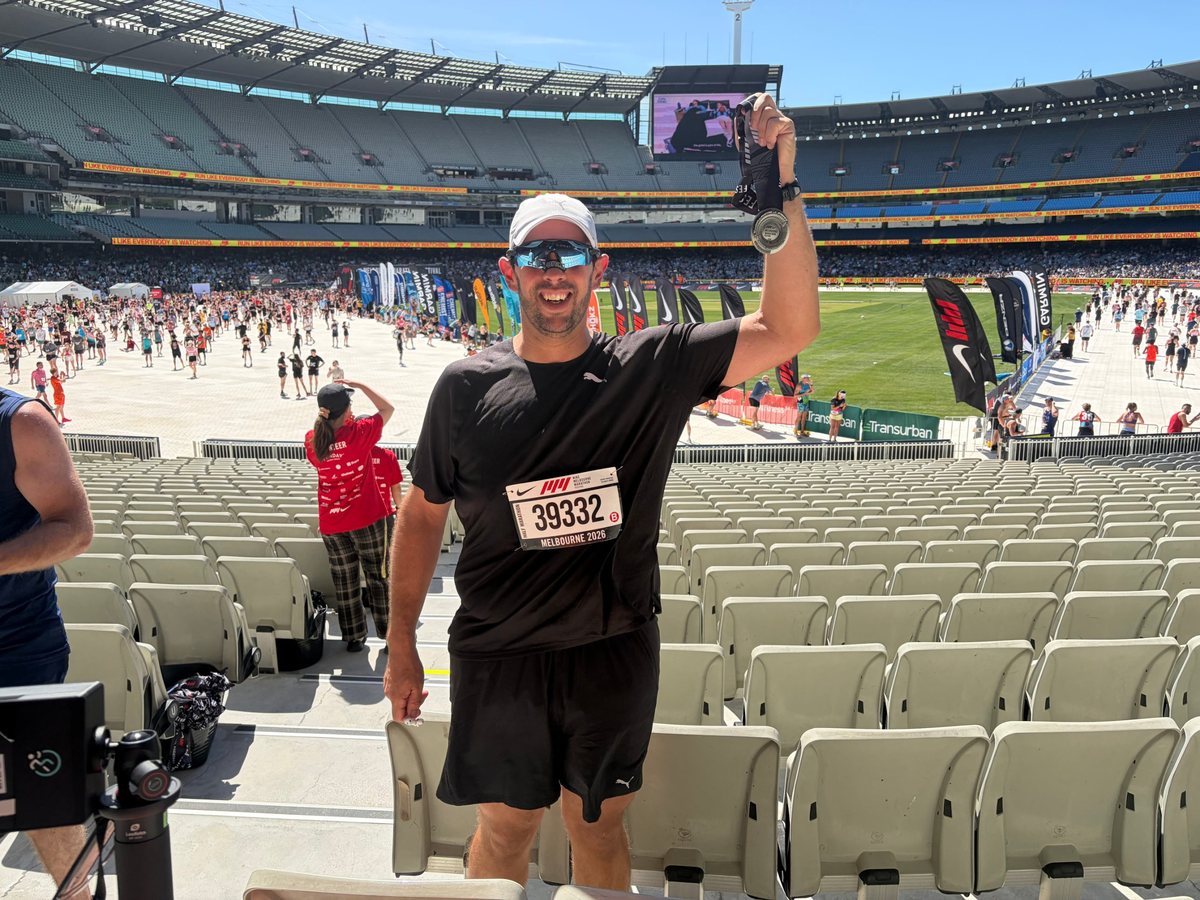
Last Sunday Berdo crossed the line at the Melbourne Half Marathon in 1:50:56. He went through 5km in 26:36 and 10km in 51:32, then finished inside the MCG with a medal in his hand and a grin you can see from the top deck.
What makes that time worth writing about is everything around it. Berdo is a dad, works full time, plays golf most Saturdays, and only started running with real structure in January. Nine months earlier his longest planned run was a 60 minute test on a treadmill.
If you are getting into running or training for your first half marathon, this is exactly how his year was built, phase by phase: the zone 2 aerobic base, the strength work, the nutrition and the race plan, with the real numbers from his programme.
Plenty of effort, not much direction
By the time Berdo came to me he had already lost a significant amount of weight and changed a lot about how he lived. He was training every day. The problem was that none of it was connected.
In his words, he was “basically just doing something every day without a clear plan.” He had signed up for HYROX, he was not seeing progress in the weights room, and he wanted to know what he was doing and why.
He also needed a plan that fitted around a family and a full time job. That shaped every week we wrote together.
Nine months, one start line
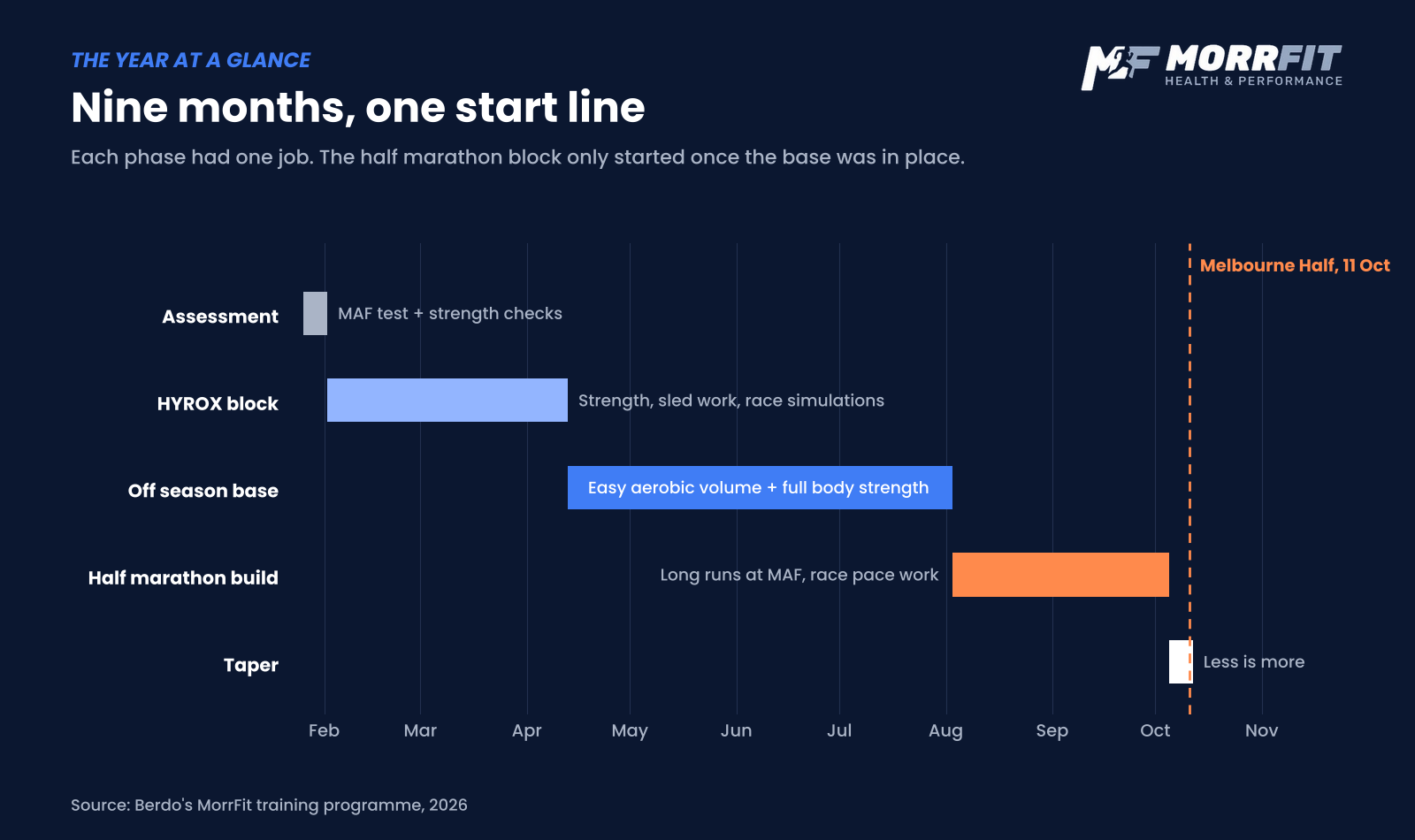
The year ran in clear phases. Each one had a single job, and the half marathon block only started once the aerobic base and strength were in place.
Testing before training
Every programme I write starts with an assessment. For Berdo that was two 60 minute MAF tests on the treadmill and three basic strength assessments.
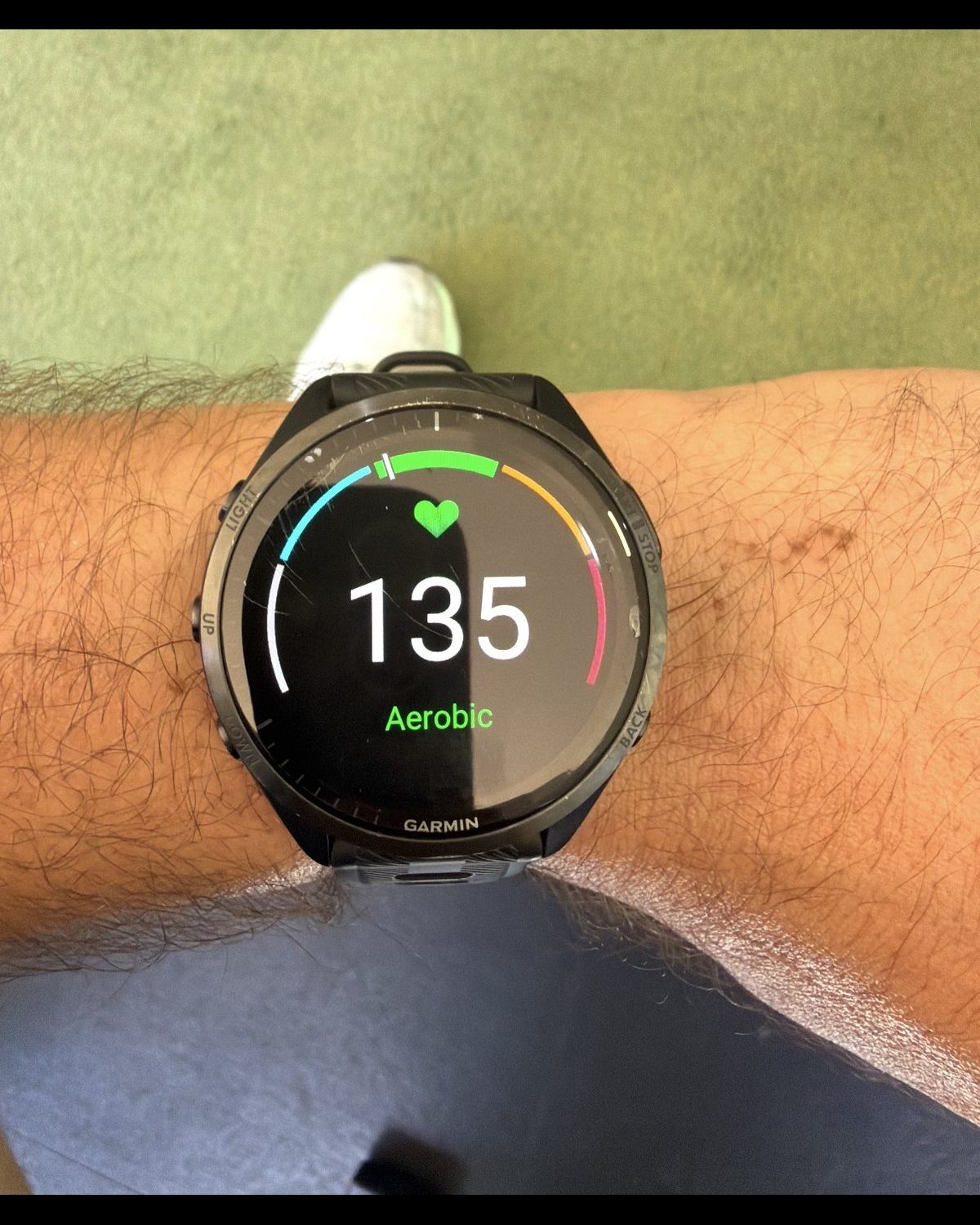
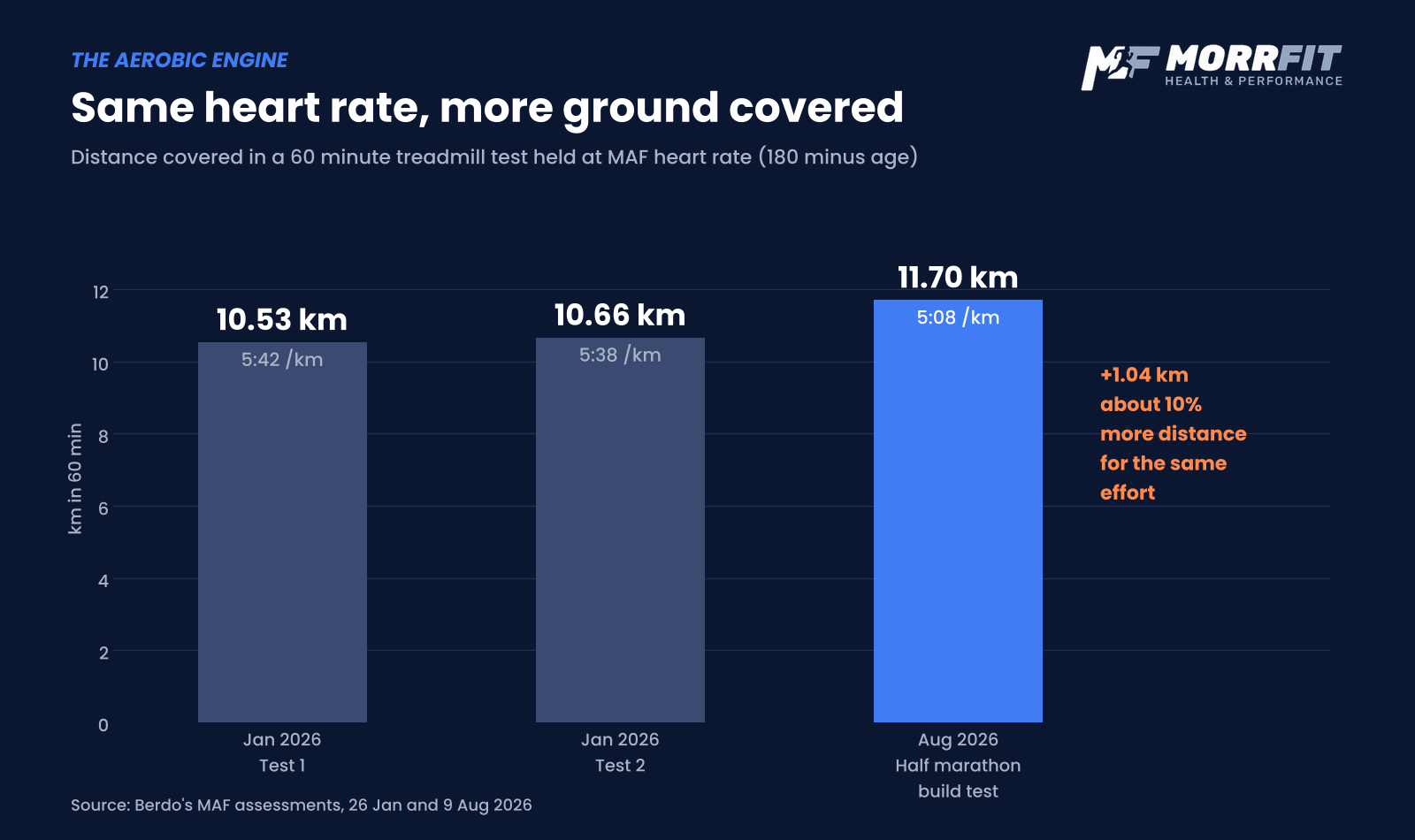
The MAF test is simple. After a short warm up, you travel for 60 minutes at a heart rate of 180 minus your age, and the speed has to change whenever your heart rate drifts up or down. Whatever distance you cover is your baseline. MAF is a heart rate based way of running easy, and for most people it sits in or close to what is commonly called zone 2. Berdo covered 10.53km and 10.66km across his two tests.
The strength checks gave us starting weights to work from: a 55kg barbell back squat, a 75kg barbell deadlift, and a pressing session where he started at 50kg on the bench and dropped to 40kg to finish the sets with good form.
The HYROX block
The first real block was built around the HYROX events Berdo had entered. That meant a lot of strength work that carries straight into the race: sled pushes and pulls, trap bar deadlifts, walking lunges, wall balls and short EMOM finishers with burpees, rowing and the assault bike.
The running in this block was short and deliberate. Run and walk intervals at 180 cadence, hill repeats on the treadmill at 5% incline, and a couple of 40 to 45 minute runs at MAF each week to keep the aerobic side ticking over.
Some of the best sessions in this block were the small ones. Micro workouts that could be done at home, 150 push ups broken up across the day, and a 45 minute run, walk and jog with the kids to the park. When life is busy, that kind of accumulation adds up.

Building the aerobic base with zone 2 running
After HYROX we went back to basics. Most weeks had three aerobic sessions and three strength sessions, and almost all of the running was slow.
The main aerobic session was a run and walk format: 4 minutes jogging at 180 cadence at or below MAF, then 2 minutes of gentle walking, repeated until 60 to 70 minutes was up. The walk is there to keep form high for longer. Over the following months the jog stretched to 5, 6 and then 7 minutes while the walk dropped to 1 minute.
We also used slow treadmill sessions at 6km/hr on a 5% incline, holding 180 cadence. It looks easy on paper. I think of it as strength training for the tendons.
In the gym, the focus moved to the legs and trunk that hold a runner together late in a race. Bulgarian split squats, Copenhagen lifts, single leg glute bridges, calf raises on both machines, pogo jumps, lateral jumps and plenty of side planks and deadbugs.
A note I left in his programme during this phase: “You know you can go harder, but it’s about hitting the appropriate energy system.” That was the whole point of this phase.
The coaching you don’t see
Slowing down was the hardest part of the whole year for Berdo. For a good part of the base phase, his easy runs had a habit of creeping above MAF, and check ins like “slightly outside towards the end” were a regular thing.
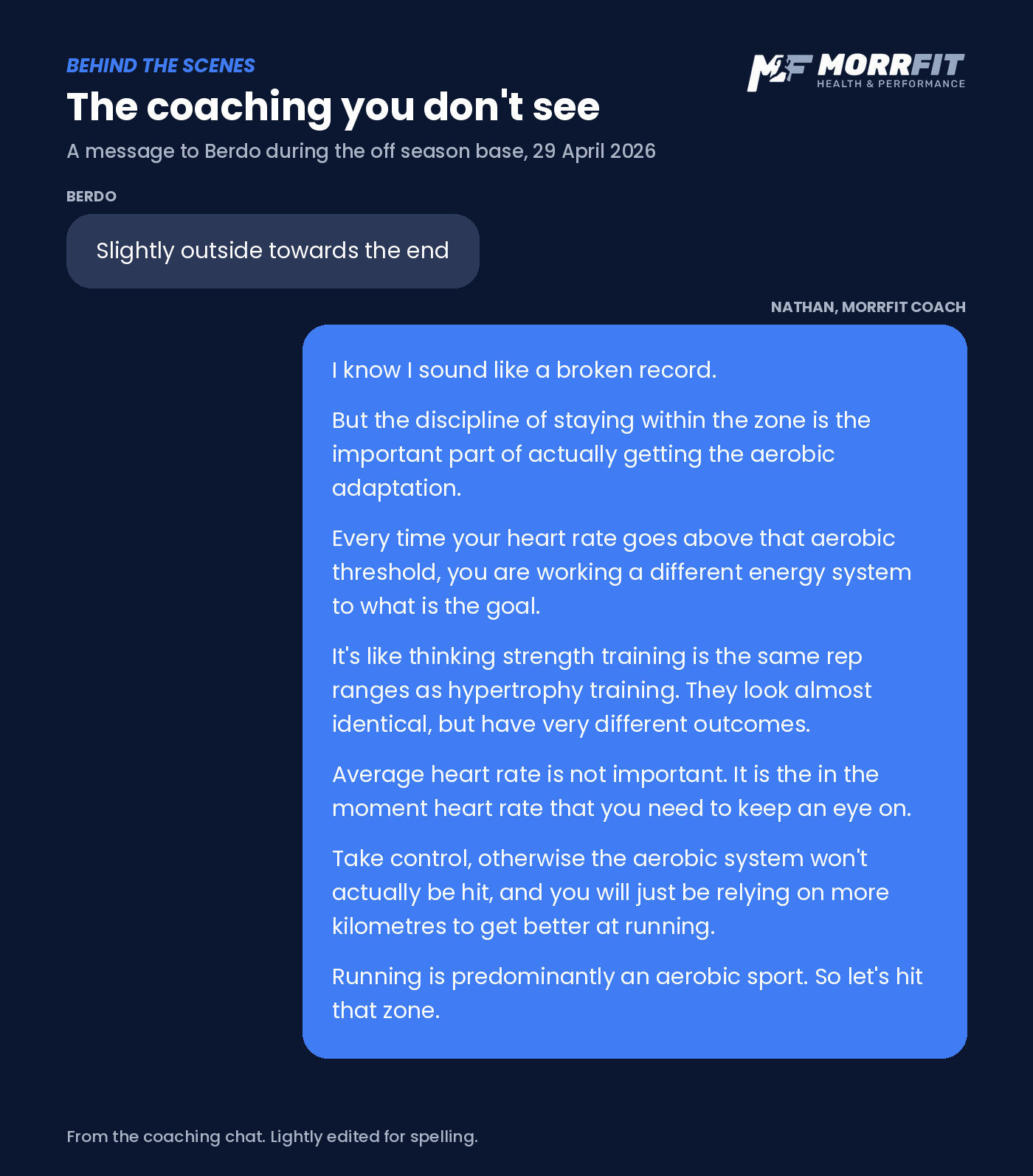
A programme only works if the sessions are done the way they are written, so a lot of my job in this phase happened between sessions. Reviewing his heart rate data, explaining why the number mattered, and saying the same thing in a different way until it landed.
This is one of those messages, sent at the end of April after another run that drifted over his ceiling.
Close enough is not the same session
A run 10 beats over MAF and a run at MAF can look almost identical on paper. Same route, similar pace, similar time. The difference is which energy system is doing the work, and that changes what the body adapts to.
The strength comparison is the one that tends to click. Training for strength and training for muscle size use rep ranges that look very similar, yet they produce different results. Easy running works the same way.
It took Berdo a while to trust the process and hold back. The August MAF test is where that patience showed up.
Same heart rate, more ground covered
In the first week of August we repeated the 60 minute MAF test to start the half marathon build. Berdo covered 11.70km. That is just over a kilometre further than January, at the same heart rate, and his MAF pace dropped from 5:38 per kilometre to 5:08.
That number told us the base was there, and that it was time to add some speed on top of it.
The half marathon training block
The build ran for about nine weeks. The weekday run and walk sessions stayed, rounded out to 70 to 80 minutes, and two strength sessions held on each week.
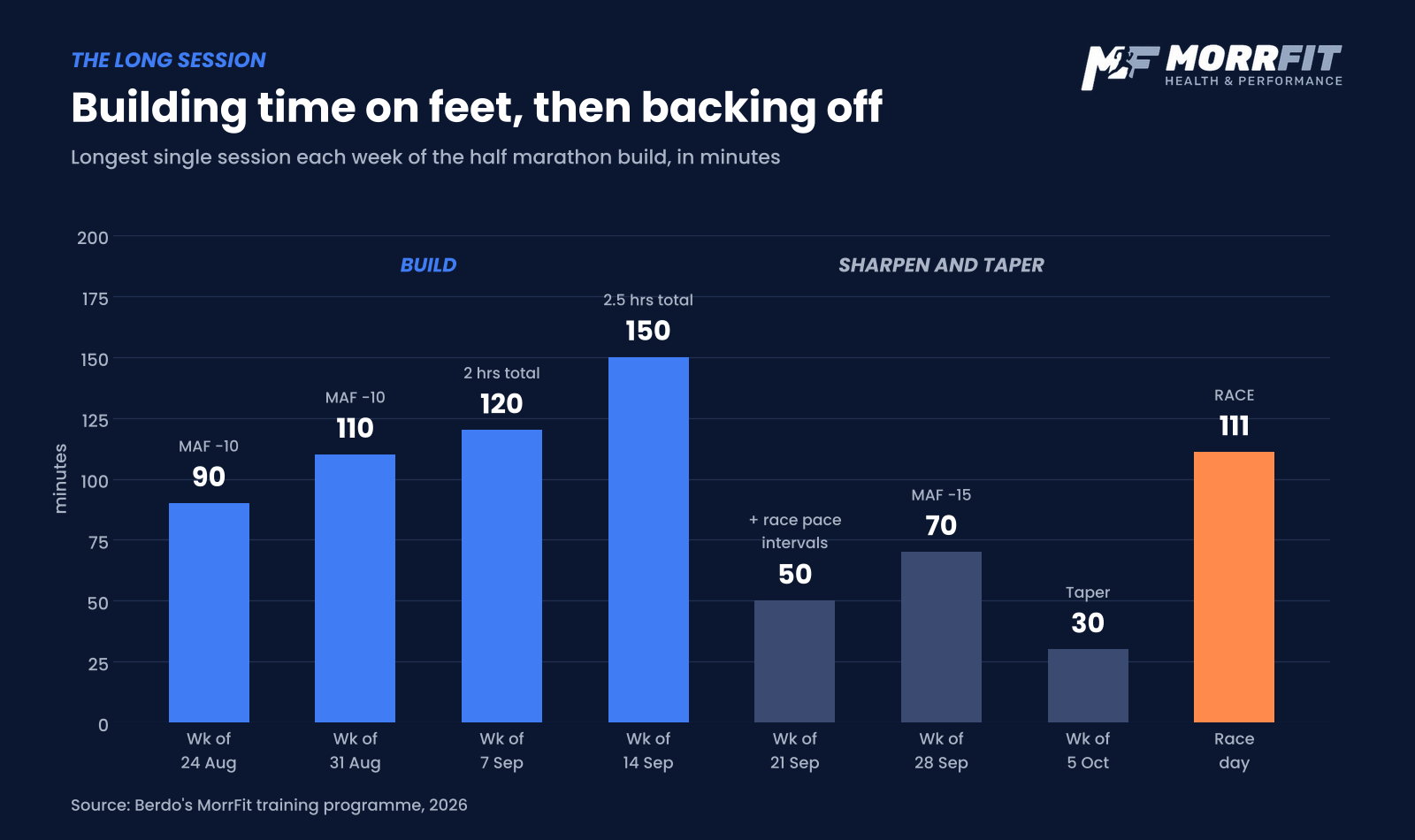
The long session grew on Sundays. It started at 90 minutes at 10 beats below MAF, then 110 minutes, then 2 hours, and peaked at 2.5 hours in the week of 14 September. The instruction each time was the same: be disciplined with heart rate.
Recovery was planned too. The week of 17 August swapped running for easy walks, stretching, a 75 minute MAF session of his choice and a Sunday of family play with a 15,000 step target. Hard weeks only work if the easy ones are actually easy.
Intervals on top of the base
Speed came in during the last month. In mid September Berdo ran 9 rounds of 3 minutes at 13 to 14.5km/hr with 2 minute cruises between. His note in the programme next to that session reads “THIS HURT!!!”
The week after, the efforts got shorter and sharper: 11 to 12 rounds of 2 minutes at 14 to 15.5km/hr, plus 10 rounds of 3 minutes at 4:45 to 5:15 per kilometre. Those sessions were also where we practised fuelling, with a target of around 50 calories every 15 minutes on the longer runs.

Four runs that taught the pacing
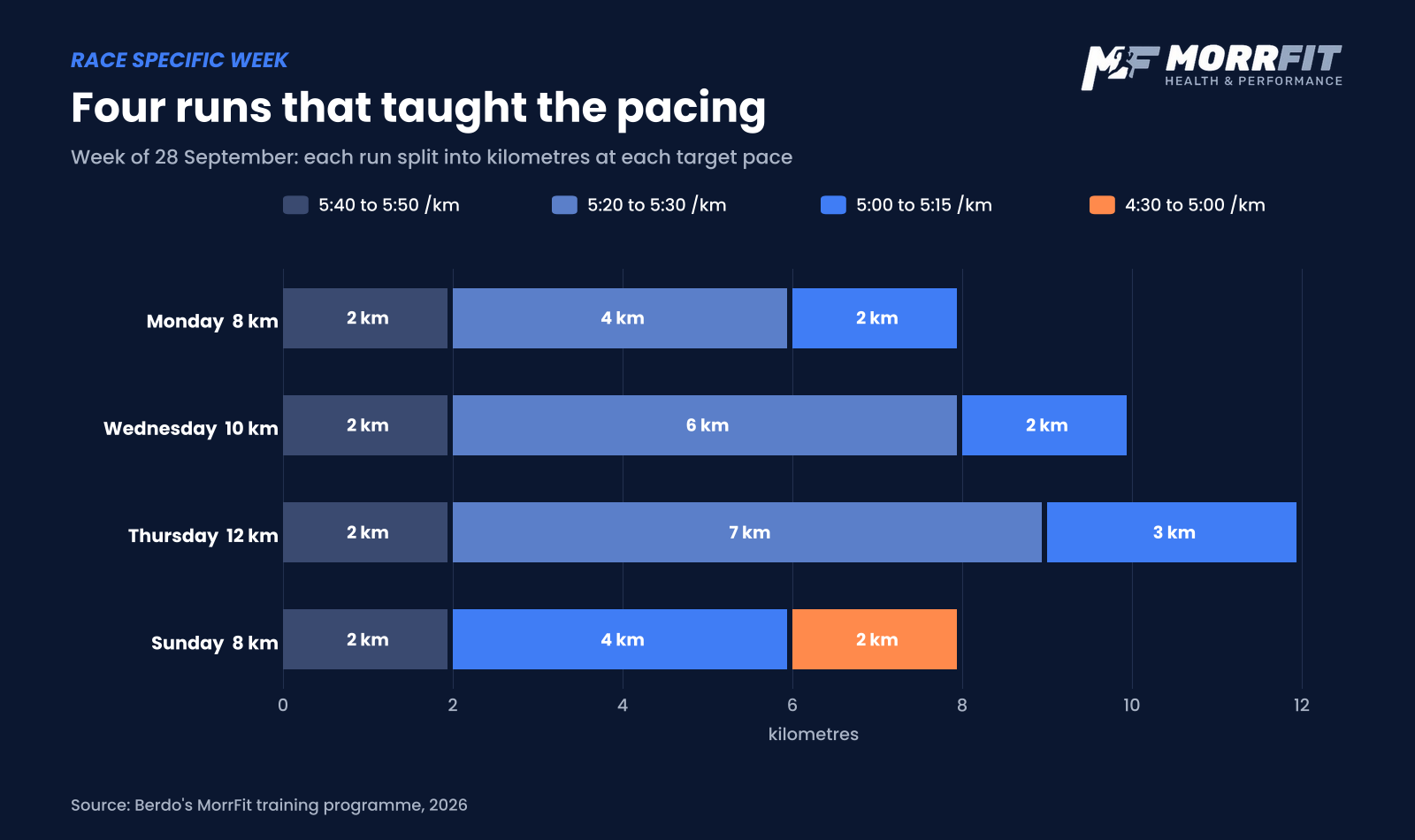
The final hard week was about rehearsing race day. Each run started easy, built through a steady middle section and finished quicker, with a note on every one: please no quicker.
Monday was 8km, Wednesday 10km and Thursday 12km, all built the same way. Sunday was 8km again, but with the last 2km between 4:30 and 5:00 per kilometre.
The taper and the race plan
Race week was mostly short, easy running at MAF, two days off the legs, and no stretching in the final days so the legs stayed springy. The note at the top of the week: remember, less is more. If it doesn’t feel right, don’t do more.
Race morning had its own routine. Walking high knees and butt kicks, leg swings, light pogo jumps, then 5 to 7 minutes slightly harder to lift the heart rate before the start.
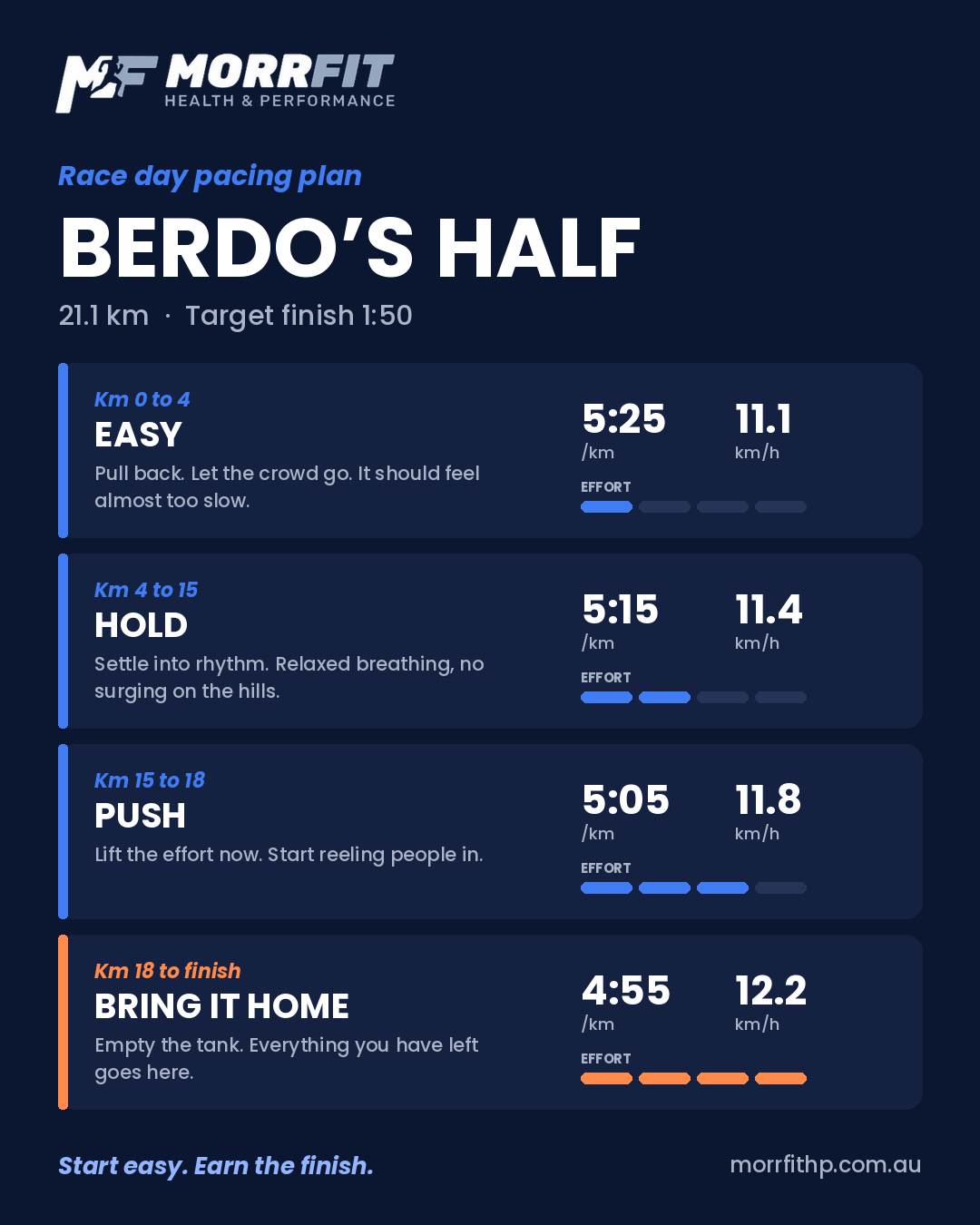
We also gave him a simple pacing plan in four parts: easy for the first 4km, hold from 4km to 15km, push from 15km to 18km, then bring it home.
The gym work never stopped
Berdo kept lifting all year, including through the half marathon build. A few of his logged working weights from early in the year against his latest:
- Trap bar deadlift from 50kg to 100kg.
- Sled pull from 60kg to 110kg total.
- Barbell back squat from 55kg to 65kg for sets of 8.
- Assisted chin ups from 80kg of machine assistance down to 55kg.
For everyday runners, strength work is often the first thing to go when life gets busy. For Berdo it stayed in every week, and it is a big part of why he could hold his form in the back half of a 21km race.
Tracking food from April
In late April, at the start of the off season, we started tracking Berdo’s nutrition properly. Every day he logged what he ate, his steps, the calories burned in training and a morning weigh-in. Protein was tracked from day one, and carbs, fats and fibre were added in June.
The setup was simple. He had a base calorie target for everyday life, and the calories from each day’s training were added on top. Big training days meant more food, rest days meant less, and the sheet showed at a glance whether he was over or under for the day and the week.
Weighing and logging everything takes work. Berdo said it himself: before we started, “there’s no chance you would have seen me weighing food, tracking properly, and consistently ticking the boxes every day.”
Building intake up before pulling it back
Berdo had already lost a lot of weight before he came to me. The first job was to make sure he was not stuck eating too little to train well.
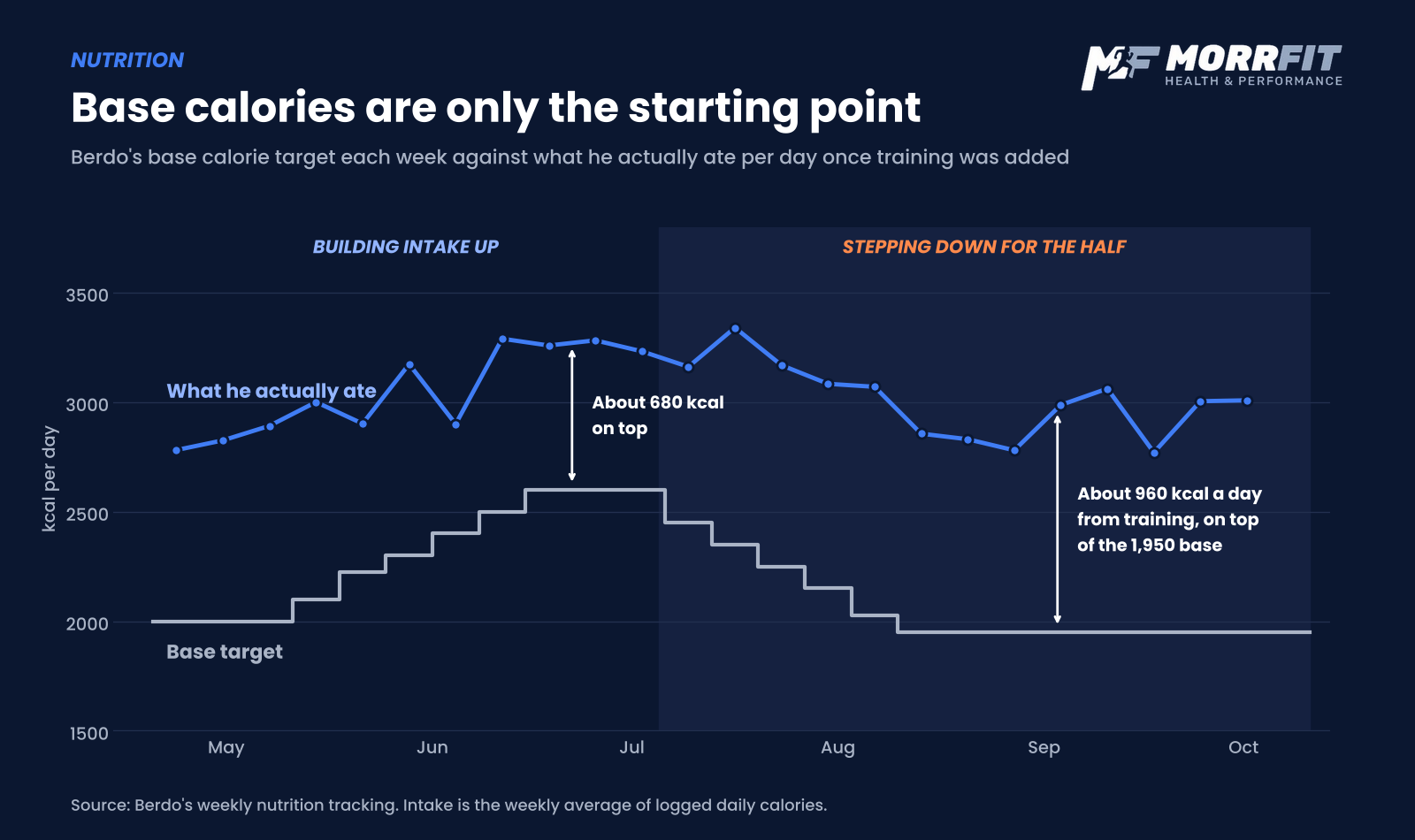
One thing to be clear on before the numbers. The base target is not what Berdo ate. It is the starting point for an ordinary day with no training. Every session he did added its calories on top, so his real intake was always well above the base.
For the first two months we raised that base, roughly 100 calories at a time, from 2,000 calories a day in April to 2,600 by mid June. With training added, his real intake went from about 2,800 calories a day in April to around 3,300 through June and July.
I would rather bring someone out of a deficit before it bottoms out than push it so low they have nothing left to climb back out with. Building food back up slowly, without the scales going the wrong way, is often the hardest part of the whole process.
From July, as the half marathon block got closer, we stepped the base back down by about 100 calories a week until it sat at 1,950 in mid August. That figure on its own looks low for a man training for a half marathon. It was never the whole picture.
Once his training was added each day, Berdo averaged about 2,900 calories a day from mid August through to the race, roughly 960 calories above his base. Across almost six months of tracking he averaged just over 3,000 calories a day.
More food, and the scales still moved
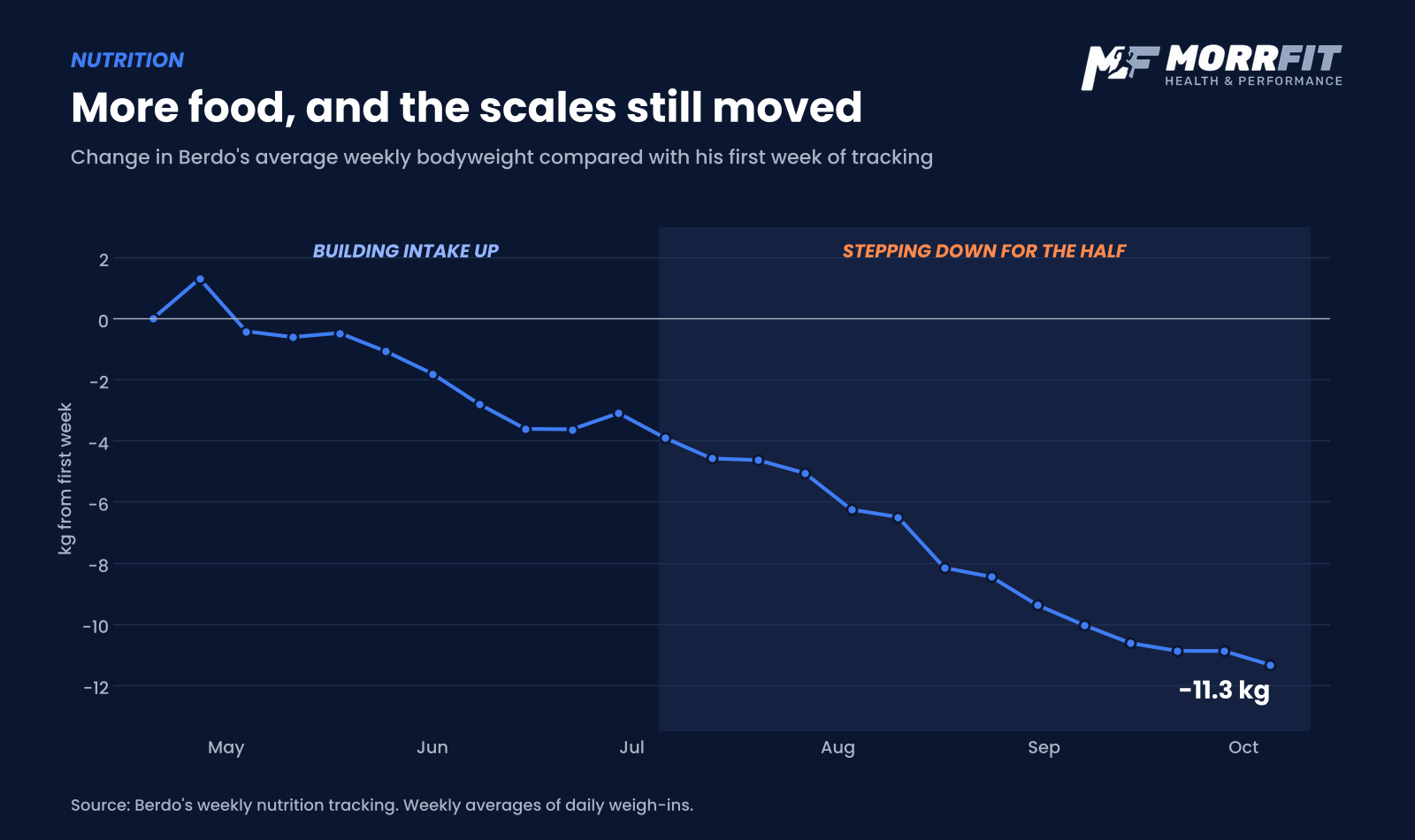
Here is the part that surprises most people. While his food was going up in May and June, Berdo’s weekly average weight still came down by about 3.5kg.
Once the base stepped down through July and August, the trend kept going. From his first week of tracking to race week, his weekly average dropped by 11.3kg, while he was eating around 3,000 calories a day and training for a half marathon.
Daily movement was a big part of that. His step count averaged between roughly 11,000 and 20,000 a day across the whole period, with the week of 3 August averaging just over 20,000.
A target that became a habit
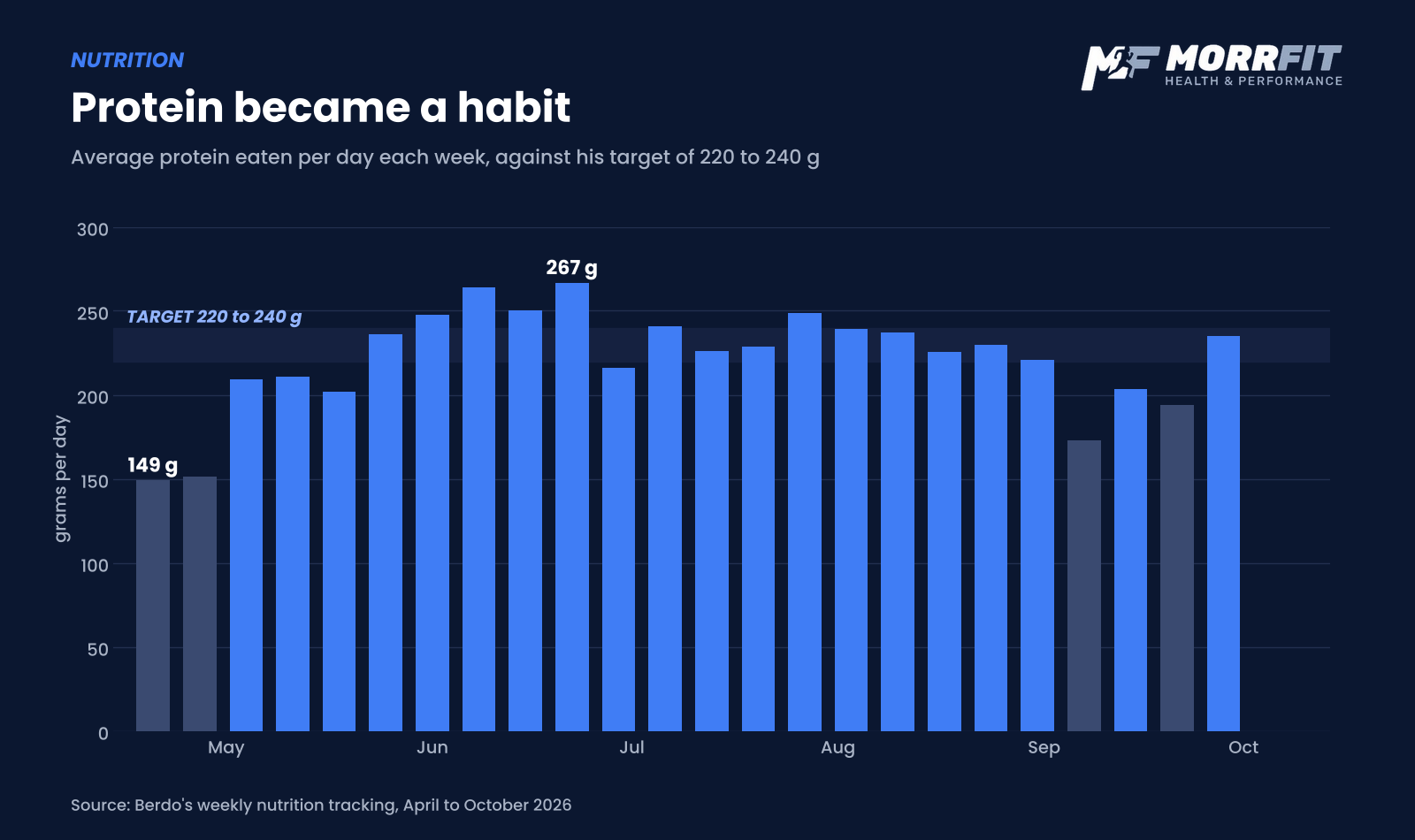
Berdo’s protein target was 220 to 240 grams a day. In his first week of tracking he averaged 149 grams.
By May he was above 200 grams most weeks, and through June he was hitting 250 grams or more, peaking at a 267 gram daily average. For most of the half marathon build he sat inside or close to the target range.
Fuelling on the run was part of the plan too. On the longer race pace sessions in September the recommendation was around 50 calories every 15 minutes, so race day fuelling was something he had already practised.
After the race the targets eased right off: 2,300 to 2,800 calories a day, protein between 180 and 220 grams, and carbs and fats as he liked.
Training around everything else
None of this happened in a vacuum. Berdo’s programme has golf on Saturdays, weeks away for work, and sessions moved around when the kids needed him. When he was travelling the instruction was simple: add any extra minutes at MAF you can, without giving up sleep.
That flexibility is what kept him consistent for nine months. A plan only works if it fits the life it sits in.

What Berdo says about the process
I asked Berdo a few questions about working together. On what changed, he said the biggest gains have been “structure, consistency, and motivation. I now train with purpose and have built habits that feel sustainable long term.”
On what he is most proud of: “My consistency, especially with training and nutrition. Before working with Nathan, there’s no chance you would have seen me weighing food, tracking properly, and consistently ticking the boxes every day.”
And on life outside training: “It has given me structure, positively influenced my family dynamic, and changed the way my kids view health, exercise, and routine.”
Working with you doesn’t feel like working with a coach or PT. It feels like having another team member in your corner.
Berdo HYROX, then the Melbourne Half Marathon in 1:50:56
Berdo came to MorrFit wanting structure around his training. Nine months later he has a stronger aerobic base, stronger lifts and a half marathon finish he planned for.
Enquire about coachingGot an event on the calendar?
Whether it is your first 5km, a half marathon or a trail race, the process is the same. We test where you are, build the base, add the speed on top, and fit it around the life you already have.
If you would like a half marathon training plan built that way, around your work and family, get in touch and we can start with an assessment.