

Round one was the training
Back in August I shared Parvin’s story. Three years of 6am group classes, five days a week, and her body hadn’t changed. Ten weeks into a structured program, the change she’d wanted finally started to show.
That first stage was all about the training. Proper strength sessions, easy aerobic work at the right heart rate, and a plan built around her week.
Since then we’ve added the next piece. We’re now working on her food as well, and what happened is something I see all the time.

For anyone doing the work and still waiting
Before I get into the numbers, here’s where Parvin is today. We’ve finished building her food up, and she’s now in her fat loss phase. Each week we’re bringing her intake down a little. We’re still in the early weeks, and so far nothing much has happened on the scale.
This is the hard stage. She’s doing all the work, she’s watching her calories come down, and each week gets a bit harder. But nothing changes straight away.
If you’re reading this in the middle of it yourself, putting in the work and not seeing much yet, this part is for you.
The thing about changing your body is that it’s all delayed. You can’t pay for the product and walk home with it. It’s months of days, and days of decisions, that slowly point you in a direction.
That’s why it’s so hard to stay motivated. You do the right thing today and nothing happens. You do it again tomorrow and still nothing.
Simon Sinek explains this really well. Go to the gym, come home and look in the mirror, and you’ll see nothing. Do it again the next day, and you’ll still see nothing. As he puts it, “Going to the gym for nine hours does not get you into shape. Working out every day for 20 minutes gets you into shape.” You just can’t tell which day it happens.
Then you hit what I call the waterfall effect. You keep stacking the weeks, it feels like nothing is moving, and then you reach that sweet spot and it all starts to go. Once it starts, it’s very obvious.
So if you’re in that stage right now, keep going. The work you’re doing this week is the result you’ll see in a few months.
Training hard, eating like she wasn’t
When Parvin first started logging her food in late July, her days ranged from about 1,200 to 2,000 calories. Across the days she logged, she averaged about 1,630 a day.
That might sound reasonable. But she was doing three to four strength sessions a week, aerobic sessions on top, and walking 8,000 to 14,000 steps most days. For that much work, it was low.
This is the most common thing I find when I start working on someone’s nutrition. Most people aren’t eating too much. They’re eating too little for the work they’re asking their body to do.
Almost 600 more calories a day
Instead of cutting, we went the other way. Every week or so we nudged her base target up a little:
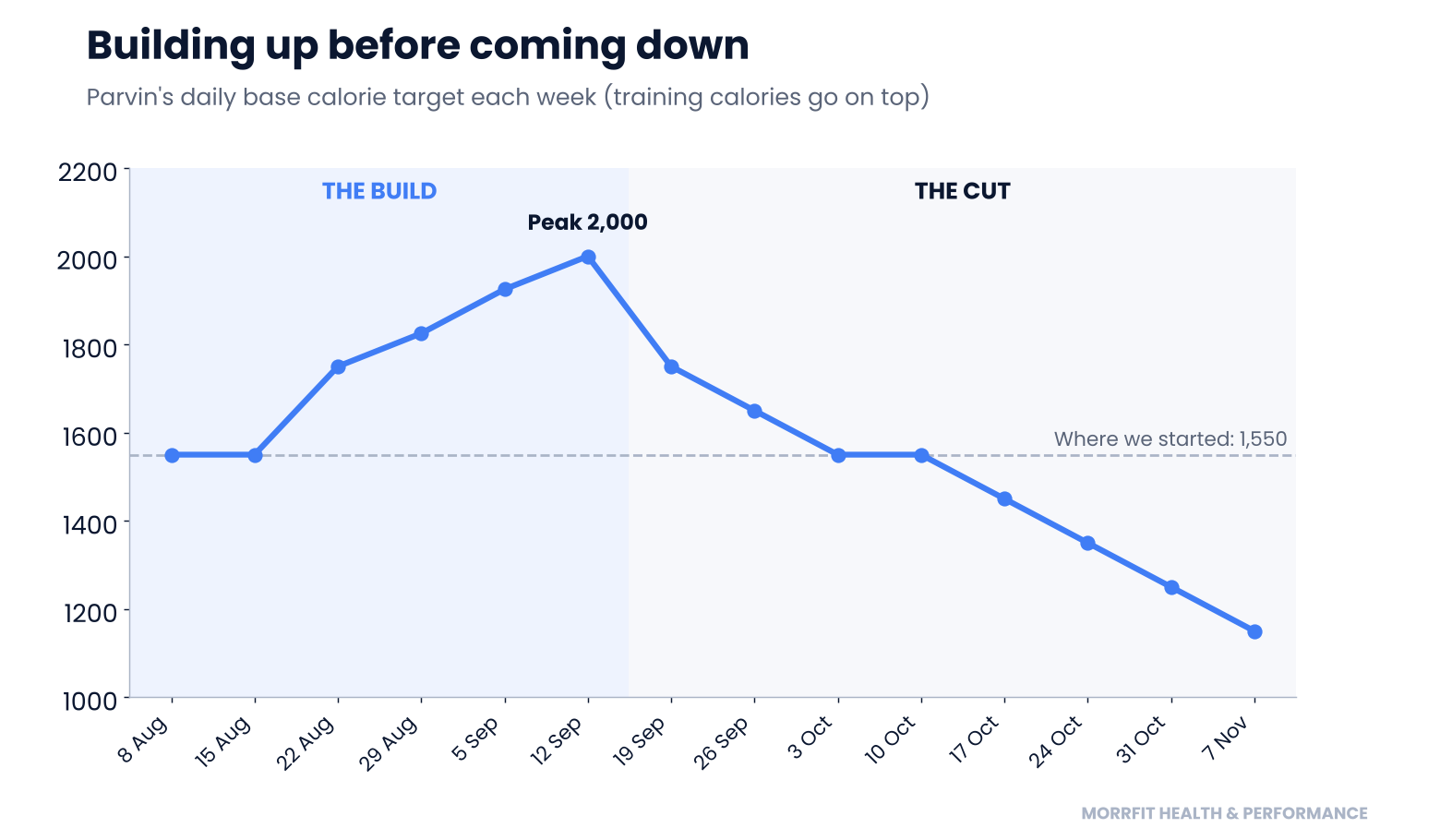
- Early August: 1,550 calories a day as her base, with training calories added on top.
- Late August: up to 1,750, then 1,825.
- Early September: 1,925, then 2,000 at the peak.
Protein stayed steady at around 120g a day, roughly 2g for every kilo she weighs. Most of the extra food came from carbohydrates, which went from about 150g a day to about 235g.
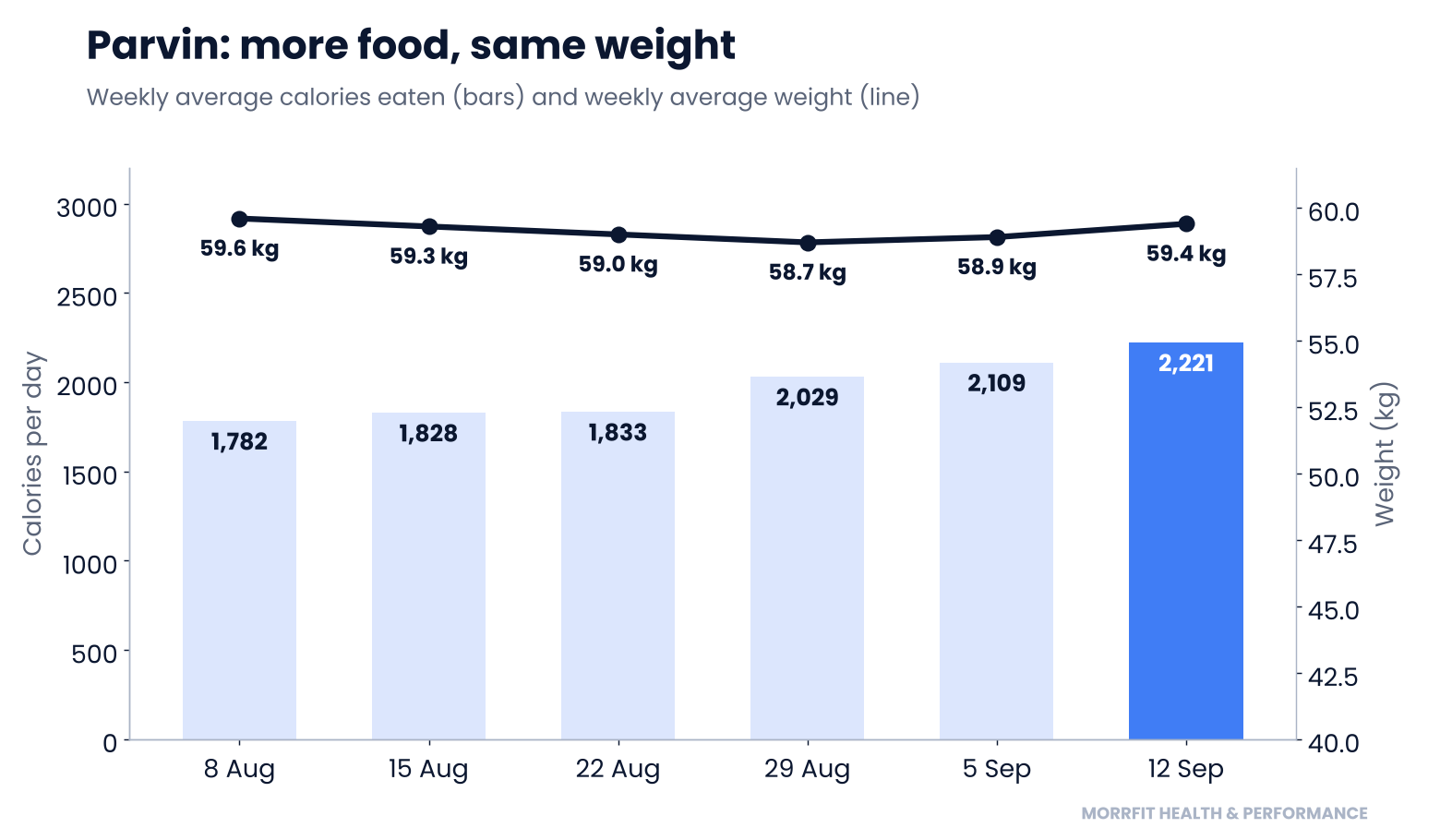
By the week of 12 September, Parvin was averaging 2,221 calories a day. That’s almost 600 more a day than when she started logging.
What the food was fuelling
During the build, Parvin was doing four strength sessions a week: two upper body and two lower body, with an easy aerobic session as an optional extra. Here are two from the week of 7 September, the same week as the day of eating below.
Upper body
- 3 easy warm up sets, then 5 working sets of 8 seated cable rows
- 5 rounds of 12 flat dumbbell bench press and 8 full range push ups
- 5 rounds of 8 seated chest press and 10 to 12 bench tricep dips
- 6 sets of 10 to 12 cable crunches, close to failure
Lower body
- 2 to 3 easy warm up rounds
- 5 hard rounds of 15 wide belt squats, with 2 to 3 minutes rest
- 6 rounds of 12 lying hamstring curls and a 60 second wall sit
- 5 rounds of a heavy TRX sled drag
Aerobic (optional extra)
- 20 minute easy walk, then 4 rounds of 8 minutes just under her MAF heart rate, with 2 minutes rest
Most working sets are at about 80% effort: hard, with a couple of reps left in the tank. That’s a lot of work to do on 1,600 calories a day, and it’s why the extra food mattered.
What 2,000 calories looks like for Parvin
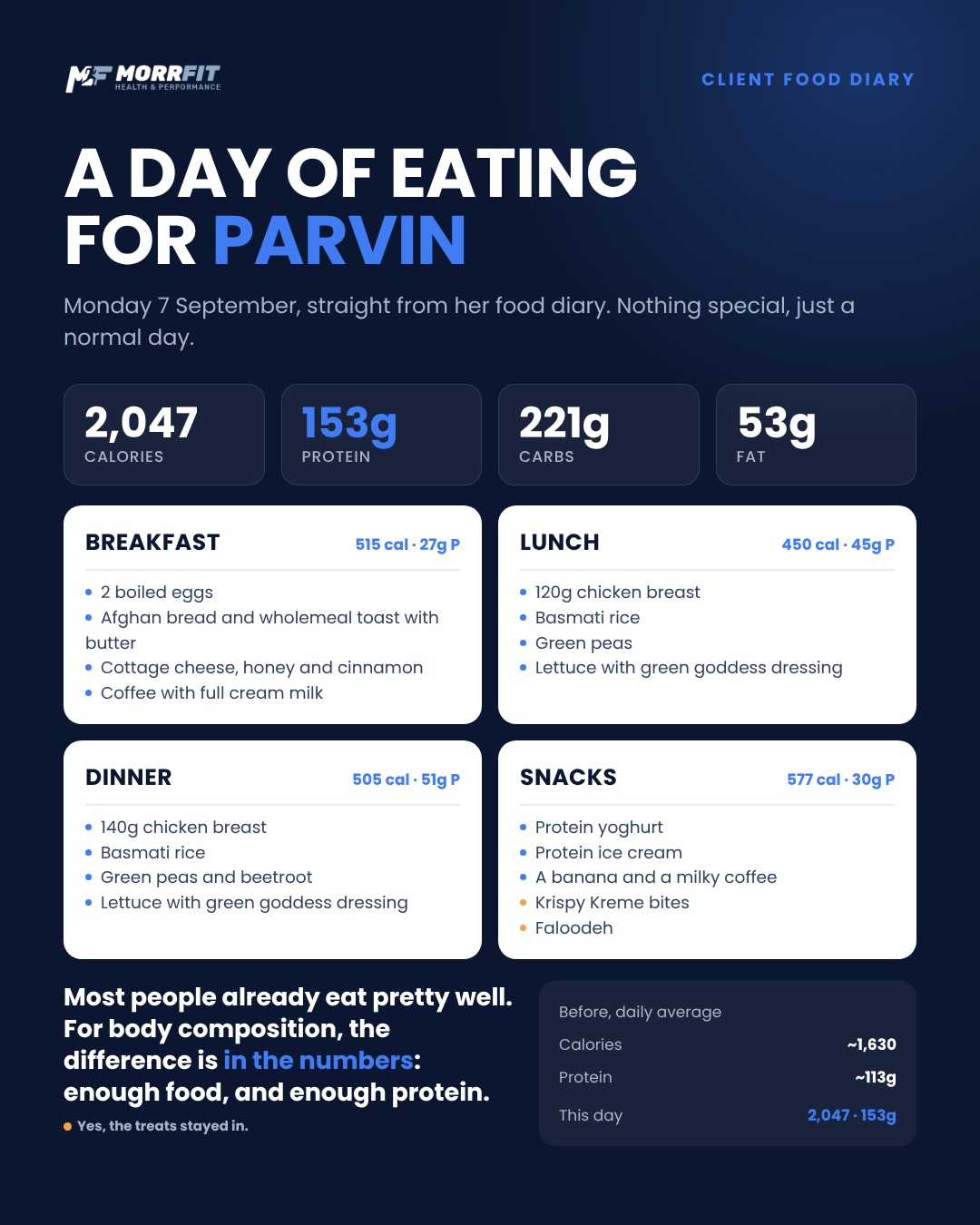
Here’s a real day from her food diary during the build. Eggs and toast, chicken and rice twice, plenty of veg, some protein snacks, and yes, Krispy Kreme bites and faloodeh.
Most people already eat pretty well. Parvin did too. The foods didn’t change much. What changed was the amount, and how much protein she got across the day.
Her weight didn’t go anywhere
This is the part that surprises people. Over those six weeks, her weekly average weight went from 59.6kg to 59.4kg. The lowest week was 58.7kg, in the middle of the build.
Eating more didn’t make her gain weight. What it did do was give her the energy to train well, recover between sessions and keep her steps up.
She noticed the difference too. In October she sent me a message with some photos, comparing herself now with April:

“I shared this with girls at the gym… My abs, my arms, shoulder… Just wanted to share with you and say thank you! I enjoyed seeing myself like that.”
Parvin MorrFit client, October 2026
Why the extra food didn’t turn into extra weight
What happened with Parvin lines up with what the research shows. A few studies explain the pieces.
- Your body spends more when you eat more. In a well known study in Science, 16 adults ate 1,000 extra calories a day for eight weeks. How much fat they gained varied about tenfold between people. The biggest reason was that many of them moved more without realising it, through things like fidgeting, standing and walking. That accounted for about two thirds of the extra energy they burned (Levine et al., 1999).
- Eating too little for too long slows things down. A review on dieting athletes describes how long periods of low intake lead the body to burn less energy, through hormone changes and less day to day movement. The authors suggest bringing intake back up gradually after a diet (Trexler et al., 2014).
- A big deficit gets in the way of building muscle. A 2022 meta-analysis found that people training with weights in an energy deficit built less muscle than people who weren’t. A deficit of about 500 calories a day was enough to stop muscle gains, even though strength still improved (Murphy and Koehler, 2022).
- Protein matters, up to a point. A review of 49 trials with 1,863 people found the benefit of protein for muscle gains levelled off at about 1.6g per kilo of body weight a day (Morton et al., 2018). Parvin sits a little above that.
- Under-fuelling affects more than weight. The International Olympic Committee’s 2023 statement on low energy availability lays out how not eating enough for your training affects both health and performance, in women and men (Mountjoy et al., 2023).
To be fair to the science, no trial has directly tested this exact approach of slowly building calories up before a cut. But each part of it is well supported, and I see it play out with clients again and again.
Starting the cut from 2,000, not 1,550
Now that her intake is built up, we’ve started the fat loss phase. The difference is where it starts.
If we’d cut from 1,550, there wouldn’t have been much room to come down before her training and energy started to suffer. Starting from 2,000 means we can bring her base down slowly, mostly in steps of about 100 calories a week, and she’s still eating a good amount of food the whole way.
Coming down in small steps also keeps each change easy to live with. And the plan isn’t a straight line of restriction. Building in days or weeks where she eats more is part of it, and the research backs that up.
- Diet breaks make a diet easier to stick to. In the ICECAP trial, 61 people who lift weights, 32 of them women, dieted for 12 weeks. One group dieted the whole time. The other had a week back at maintenance after every three weeks of dieting. Both lost a similar amount of fat, but the diet break group felt less hungry, had less desire to eat and were more satisfied with their diet (Peos et al., 2021).
- Higher calorie days help hold on to muscle. In a seven week study of men and women who lift weights, one group dieted five days a week and had two higher carbohydrate days. The other dieted every day. Fat loss was about the same, but the group with higher days kept more of their lean mass and their resting metabolism dropped less (Campbell et al., 2020).
In plain terms, a plan you can stick to beats a stricter one you can’t.
We’re still in the early weeks of this phase, so there’s more to come. I’ll share how the cut goes once we’re through it.
The two things that keep weight off
Losing fat is one part. Keeping it off is where most people come unstuck. The research on people who’ve lost weight and kept it off keeps pointing to two things: some level of restriction, and some form of management.
- Some level of restriction. Not a strict diet forever, but a sensible ceiling on how much you eat. The National Weight Control Registry follows thousands of people who’ve lost at least 13.6kg and kept it off for at least a year. Most of them keep eating a moderate amount, eat breakfast regularly, keep their eating fairly similar on weekdays and weekends, and do around an hour of activity a day (Wing and Phelan, 2005).
- Some form of management. Keeping an eye on things in a way that suits you. In the same registry, people who weighed themselves consistently regained less weight over the following year than people who weighed in less often (Butryn et al., 2007). A review of 67 studies found the habits that predicted keeping weight off were the ones that kept food intake in check, kept activity up and kept track of the balance between the two (Varkevisser et al., 2019).
For my clients, that might look like:
- Weighing in a few mornings a week and watching the weekly average, not the daily number.
- Logging food for a week whenever things start to drift.
- A handful of go-to meals that hit their protein without thinking about it.
- Higher calorie days that are planned, rather than every weekend turning into one.
- Keeping training in the week, every week.
This is hard, and I’m proud of her
I want to be honest about something. Even with a plan, a coach and the numbers laid out week by week, this is hard. Eating more when everything you’ve ever heard says eat less is hard. Getting 120g of protein in on a busy day is hard. Coming back down once you’ve got used to more food is hard.
Parvin has done all of it while working, training and living her life. She’s logged her food, turned up to her sessions and trusted the process, even when the scale wasn’t telling her much. I’m really proud of her.
For a lot of people, the biggest challenge isn’t knowing what to do. It’s doing it on the days they don’t feel like it. People often call that their willpower muscle.
What’s actually happening in your brain
Willpower isn’t a muscle in the literal sense, but the idea has some real science behind it:
- The decision maker. When you choose between something tempting and something that fits your goal, the dorsolateral prefrontal cortex, an area just behind your forehead, gets involved. In a brain scanning study of dieters, the people with good self-control had more activity there, and it helped their brain weigh health alongside taste when choosing food (Hare et al., 2009).
- The keep going area. A region called the anterior mid-cingulate cortex is linked to tenacity: pushing on when something feels effortful or uncomfortable. Researchers have found it is one of the areas that stays thicker in “superagers”, people in their 80s whose memory is as sharp as people decades younger (Touroutoglou et al., 2020).
- Repetition makes it easier. In a study of people building a new healthy habit, it took a median of 66 days for the habit to feel automatic, with a range of 18 to 254 days. Missing a single day didn’t undo their progress (Lally et al., 2010).
Scientists still debate how far you can train willpower directly. What the research does show is that doing a hard thing over and over makes it feel less hard, and that one missed day doesn’t wipe out the work.
So every time Parvin weighed her food when she didn’t feel like it, or got her protein in on a busy day, she was practising. That’s where resilience comes from: lots of small, hard choices, repeated until they’re just what you do.
If you’re finding it hard, that’s normal, and you’re in good company. Everyone I coach has days where it feels like too much. Those are the days that count the most.
If you’re training hard and not seeing it
Log a normal week of food, including the weekends. Then compare it with how much you’re actually training and moving.
If the numbers are low for the work you’re doing, eating less probably isn’t the answer. Often it’s the opposite.

Training hard and eating less, with nothing to show for it?
Coaching Training and nutrition, built around your week
We look at both, so you’re eating enough to train well and still reach your goal.
Book your assessmentThe studies mentioned
- Levine JA, Eberhardt NL, Jensen MD. Role of nonexercise activity thermogenesis in resistance to fat gain in humans. Science, 1999.
- Trexler ET, Smith-Ryan AE, Norton LE. Metabolic adaptation to weight loss: implications for the athlete. Journal of the International Society of Sports Nutrition, 2014.
- Murphy C, Koehler K. Energy deficiency impairs resistance training gains in lean mass but not strength: a meta-analysis and meta-regression. Scandinavian Journal of Medicine and Science in Sports, 2022.
- Morton RW et al. A systematic review, meta-analysis and meta-regression of the effect of protein supplementation on resistance training-induced gains in muscle mass and strength in healthy adults. British Journal of Sports Medicine, 2018.
- Mountjoy M et al. 2023 International Olympic Committee’s consensus statement on Relative Energy Deficiency in Sport (REDs). British Journal of Sports Medicine, 2023.
- Peos JJ et al. Continuous versus intermittent dieting for fat loss and fat-free mass retention in resistance-trained adults: the ICECAP trial. Medicine and Science in Sports and Exercise, 2021.
- Campbell BI et al. Intermittent energy restriction attenuates the loss of fat free mass in resistance trained individuals: a randomized controlled trial. Journal of Functional Morphology and Kinesiology, 2020.
- Wing RR, Phelan S. Long-term weight loss maintenance. American Journal of Clinical Nutrition, 2005.
- Butryn ML, Phelan S, Hill JO, Wing RR. Consistent self-monitoring of weight: a key component of successful weight loss maintenance. Obesity, 2007.
- Varkevisser RDM et al. Determinants of weight loss maintenance: a systematic review. Obesity Reviews, 2019.
- Hare TA, Camerer CF, Rangel A. Self-control in decision-making involves modulation of the vmPFC valuation system. Science, 2009.
- Touroutoglou A, Andreano J, Dickerson BC, Barrett LF. The tenacious brain: how the anterior mid-cingulate contributes to achieving goals. Cortex, 2020.
- Lally P, van Jaarsveld CHM, Potts HWW, Wardle J. How are habits formed: modelling habit formation in the real world. European Journal of Social Psychology, 2010.