

Almost nobody walks in the door wanting to run an ultra.
If you look around the MFHP Adventures community right now, you will see people training for fun runs, trail races, adventure races, half marathons, marathons and ultras. Most of them did not start there. Very few clients have ever come to me on day one and said “I want to run 50 kilometres”.
What they actually say is smaller and a lot more honest.
“I just want to get fitter again.”
“I want to lose a bit of body fat and feel better in myself.”
“I want to walk or hike on the weekend without feeling wrecked.”
“I want to run a local parkrun without stopping.”
“I want to feel confident saying yes to events instead of avoiding them.”
That is how every big goal I have ever seen starts. A small, honest intention. Then strength improves, confidence builds, capacity grows, and the person who doubted themselves eighteen months ago is standing on a start line they never pictured. You can read a few of those stories here.
So the goal is not the hard part. Goal setting is a process, and the process is the bit people skip. Here is how I set one up.
Saying it out loud is not goal setting
I have fallen into this trap plenty of times myself. We say things like “I’m going to train more this year”, or “I’m going to get fitter”, or “I’m going to be more consistent”.
The intention is good. The commitment is vague. And vague commitments are the first thing to go when work ramps up, the kids get sick, motivation dips, or the routine breaks. Which it will.
This is why how you set the goal matters as much as what the goal is. You have probably seen SMART goals before, but they are worth another look because they work.
- Specific. What exactly are you trying to achieve?
- Measurable. How will you know you are making progress?
- Action-oriented. What are you actually going to do?
- Realistic. Is this achievable inside the life you currently have?
- Time-bound. By when?
Miss those and the goal stays fuzzy, and fuzzy goals are easy to walk away from without ever admitting you walked away.
Step one: take an honest snapshot
Before you decide where you are going, get clear on where you actually are. This is not about judgement. It is about awareness.
Four questions worth sitting with:
- How consistent has my training really been over the last three to six months?
- What does my energy look like week to week?
- How do I feel, physically and mentally?
- What limitations am I noticing, in training and in ordinary life?
Answer those properly and you have a starting line. From there you can work out what you want out of the year ahead. Not what you think you should want. What genuinely excites you.
Step two: set the big, slightly scary one
At MFHP Adventures we talk a lot about the BHAG. Big Hairy Audacious Goal.
A good one feels exciting, feels meaningful, carries a bit of fear, and asks for commitment rather than perfection. If it does not make you a little nervous, it is probably a plan rather than a goal.
Give it eight to ten months. That timeframe is deliberate. It is long enough to train properly, long enough to learn and adapt, long enough to make mistakes, and long enough to fail forward and still get there. Anything much shorter and every setback becomes a crisis.
It might look like:
- Running your first half marathon
- Finishing a trail race
- Taking on an adventure race or a Spartan
- Building towards a marathon or an ultra
- Hitting a real strength milestone
- Changing your body composition enough that movement itself feels easier
You set the bar. What matters is that it means something to you, not to anyone else.
Once you have chosen it, spend a minute actually picturing it. See yourself crossing the line. Think about how that feels. Then think about what it will take, the training, the recovery, the gear, the head space.
And be clear on this one: there is no perfect path to any big goal. Life will interrupt. Plans will shift. Motivation will move around. That is not the plan failing, that is the plan.
Step three: work backwards
Once the big goal is set, you build the ladder down to where you are standing now. This is where the momentum actually comes from.
Short-term goals might be increasing weekly running volume gradually, entering a shorter event as a stepping stone, improving strength or mobility, hitting a consistency target like three or four sessions a week, tidying up recovery and nutrition, or learning the specific skills your event demands, hills, trails, obstacles, pacing.
What those give you is direction, regular wins, something to hold onto during a rough week, and proof that progress is happening when the big goal still looks a long way off.
This is the single biggest reason my long-term clients stay engaged. There is always something in front of them, even when the finish line is months away.
What a BHAG actually looks like
Cathy Perri is the clearest example I have. She came to me in October 2020 having run one half marathon, reading books about ultra running and wondering whether low heart rate training might get her through 50 kilometres. In her own words, she had no real idea where to begin.
In July 2022 she finished her first 50 kilometre race at The Lakes Trail Festival. In May 2023 she ran UTA50 in the Blue Mountains, 50 kilometres with around 2,500 metres of climbing, in under eight hours. She had already entered her next event before she ran the first one.
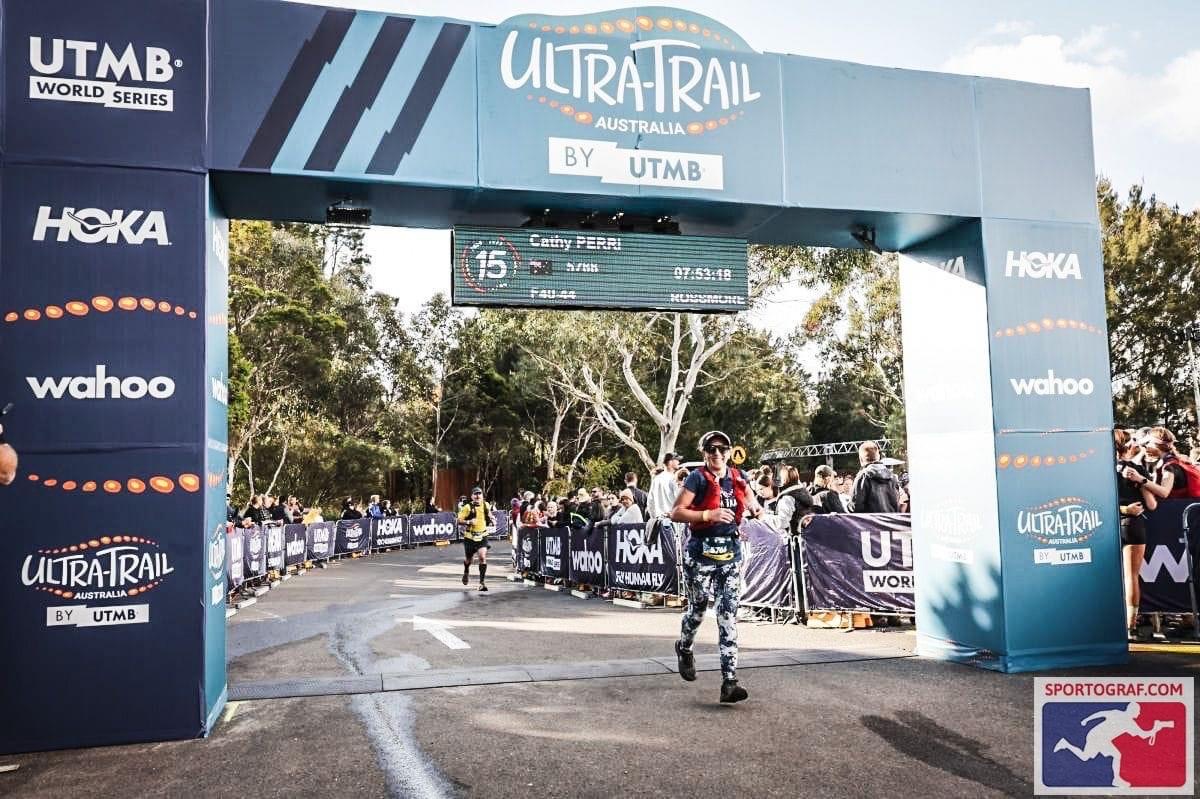
The part worth copying is not the result. Cathy’s four months of preparation were built on short form sessions, 30 to 75 minutes at low to moderate intensity, done Monday to Friday. When the week got away from her, she moved her weekend rather than writing the week off. She did the boring, monotonous work, which is exactly what makes a big goal reachable.
She is also a working mum of two. The goals did not wait for life to quieten down, because it never does. You can read the full story in Cathy Perri, super mum and ultra runner.
The short version
Set the big scary goal first. Give yourself eight to ten months. Accept that the run at it will not be clean. Work backwards into smaller goals you can actually hit. Chase consistency rather than perfection.
Whether the goal is a parkrun, a half marathon, a trail race, an adventure race, or simply being fitter and more capable for everyday life, the principles do not change. Big goals get built out of small actions repeated for a long time.
You also do not have to work it out on your own. If you are not sure how to structure the goal, the training, or the timeline, that is exactly what MFHP Adventures coaching is for.
So, what is your BHAG?